

Constant exposure to bad news and social media can leave us carrying the weight of the world before our day even begins. Learn how a simple tech detox, healthier boundaries, and purposeful action can reduce stress, protect your well-being, and help you stay engaged without burning out.
When people talk to me about feeling anxious or burned out, one of the first things I ask is what their mornings look like. More often than not, the answer is the same: phone first, headlines first, outrage first, coffee second.
It's a telling question, because so much of our daily exhaustion doesn't come from our own lives at all. It comes from everyone else's. A constant stream of global suffering, political division, and algorithm-fed negativity, absorbed before we've even gotten out of bed. In other words, a lot of people aren't just tired. They're carrying the weight of a challenging world, and the fear that comes with constant bad news.
Constant exposure to distressing content doesn't make us more prepared, more informed, or more helpful. Research on stress and media consumption consistently shows the opposite: chronic exposure numbs us, disrupts sleep, and gradually erodes our capacity to show up for the people and causes we care about. You cannot pour from an empty cup, and right now, a lot of cups are running on fumes.
I often think about this in terms of a simple continuum: Healthy, Reacting, Injured, Illness. Constant media consumption is one of the fastest ways I see people slide from Healthy into Reacting. It shows up as irritability, a shorter fuse, disrupted sleep, and a low hum of unease that never quite lifts morning through night. Left unchecked, it keeps moving people further along that continuum. The point isn't to wait until you're in crisis to make a change. It's to notice the early signs and act on them.
So where do you actually start?
Begin by separating what you can control from what you cannot. You cannot control geopolitics, economic swings, environmental catastrophes, or the outcome of a war on the other side of the world. Ruminating on those things doesn't make you more prepared. It just drains your energy and your hope.

What you can control is smaller, but it's real. How much news and social media you consume, and when. How much time you spend in nature. The quality of the relationships you choose and cultivate. And the small, tangible ways you choose to help, when and where you're able.
That last piece matters most, because purposeful action changes something that guilt never can. A donation. A volunteer shift. Checking in on someone who's struggling. Supporting a cause close to home. These things restore a sense of agency. I always say there’s no better way to heal than to help another.
If the headlines are spiking your stress, the answer isn't more willpower. It's a clear rule. Set specific windows for news rather than letting it bleed into every spare moment; once at lunch and once in the evening is plenty for most people. Turn off non-human notifications entirely. Protect the first thirty minutes of your day: no phone, no headlines.
Get outside daily, even briefly, since time in nature has a well-documented calming effect on the nervous system. Choose a real conversation with someone you trust over another hour drowning in your feed. And notice when you're reaching for your phone out of habit rather than genuine interest or need.
I've heard from countless people who describe the same pattern: they wake up, reach for their phone before their feet even hit the floor, and are already tense before the day has properly started. The people who've made the most progress aren't the ones who quit the news entirely. They're the ones who built a small buffer, even just thirty minutes, before they let the world back in.

Here's what I want to say: you can wake up excited about your day. You're allowed to laugh, to enjoy your coffee, to feel joy in ordinary moments, even while the world holds real suffering. Feeling good doesn't mean you've stopped caring. It means you've built the capacity to keep caring for the long haul, instead of burning out on outrage that changes nothing.
The world doesn't need more people running on empty. It needs people who are grounded, rested, and connected enough to actually show up, today and tomorrow, for what matters to them.
Protecting your own well-being was never indulgent. It's what makes everything else possible!
Youtube: @dr.laurawhereworkmeetslife
Facebook: @Dr.Laura.whereworkmeetslife
Instagram: @dr.laura.live
Tik Tok: @drlaura.live
X: @drlauralive
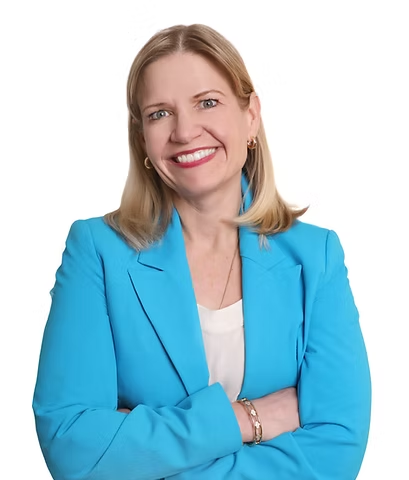
Dr. Laura Hambley Lovett is an award winning Organizational Psychologist, Keynote Speaker, Business Leader, International Bestselling Author, and Podcast Host of the highly acclaimed podcast Where Work Meets Life™. She is a sought-after thought leader on workplace psychology, the future of work, and career development with over 25 years of experience. Dr. Laura is passionate about creating cultures that attract top talent and where people stay and thrive.
Dr. Laura has founded several psychology and consulting practices, including Canada Career Counselling in 2009, where registered psychologists across the country have helped thousands of Canadians navigate their career and workplace challenges, while supporting organizations to develop thriving leaders and cultures. She holds a Ph.D. in Industrial/Organizational Psychology from the University of Calgary, where she is currently an Adjunct Professor actively conducting research on toxic leadership across North America.
Her new book about toxic bosses, I Wish I’d Quit Sooner: Practical Strategies for Navigating and Escaping a Toxic Boss, endorsed by Dr. Marshall Goldsmith, was released on January 13, 2026, and became a #1 Amazon bestseller in Workplace Process & Infrastructure, as well as an Amazon International Bestseller. Drawing from her research and decades of experience, the book offers insight, validation, and practical strategies for those navigating, escaping, and recovering from a toxic boss at any stage of one’s career.
She has published two psychological thrillers, Losing Cadence and Finding Sophie, which aim to captivate readers while raising awareness about mental health and domestic violence. These novels are currently being adapted into a television series and inspired her to co-found WITH HER, a movement to end violence against girls and women. In recognition of her impactful work, Dr. Laura received a Canadian Women of Inspiration Award as a Global Influencer in 2018.