


We all have an inner voice that can influence how we feel about ourselves, our work and our lives. Sometimes, that voice turns one mistake into a belief that we always get things wrong, or one disappointment into the fear that nothing will ever work out. But what if we challenged that nasty voice instead of letting it define our future? In this blog, Dr. Laura Hambley Lovett explores how negative self-talk and all-or-nothing thinking can affect our confidence, decisions and willingness to pursue new opportunities. She shares a practical exercise to help you recognize your inner critic and make room for a more positive, compassionate and realistic perspective.
Have you ever made a mistake and immediately told yourself you were terrible at something? Or had one disappointing experience and decided nothing was ever going to work out?
We all have that voice in our heads. Sometimes it’s a quiet whisper of doubt. Other times, it is loud and relentless, convincing us that the worst-case scenario is the only possible outcome. I see this a lot with toxic boss survivors, telling themselves they will never find a good boss again, or maybe it’s them.
Research suggests that we experience approximately 6,000 distinct thoughts each day (Tseng & Poppenk, 2020). That is a lot of opportunities for our inner voice to influence how we feel about ourselves, our work and our lives.
The cost of that nasty voice
Think about how quickly one negative thought can take over your day. You receive constructive feedback and suddenly question your abilities. One job rejection makes you believe you will never find work. One mistake convinces you that you always get things wrong.
These are examples of all-or-nothing thinking. We take one experience and turn it into a conclusion about everything. Words such as always, never, everyone and nothing can be clues that we are being too hard on ourselves. Rarely are outcomes in life so black or white.
Imagine having a friend who constantly pointed out your mistakes, dismissed your accomplishments and reminded you of everything that could go wrong. How long would you want to spend around that person? What if they were your roommate, always yapping in your ear?
Yet many of us speak to ourselves this way every day. Whether aloud or silently, the impact is the same, this voice hurts us.
When we constantly tell ourselves we’re not good enough, we may avoid new opportunities, downplay our accomplishments or give up after a setback. The goal is not to ignore our mistakes or pretend everything is perfect. It is to acknowledge what went wrong, andwhat we can learn from it moving forward, without labelling ourselves as a failure.
We can be honest with ourselves without being cruel to ourselves.

Meet your positive voice
One exercise I recommend is giving that nasty voice a name. Choose a character you dislike, perhaps a bully or someone you didn’t like growing up. Imagine that person sitting on your shoulder, criticizing everything you do.
Would you choose them as a friend? Would you want them as a roommate? No! So why let that voice have the final say?
Now imagine another voice sitting on your opposite shoulder. I call this the positive voice. It is encouraging, compassionate and realistic. It reminds you of your strengths, recognizes your progress and helps you see possibilities that your nasty voice overlooks.
Your positive voice does not promise that everything will work out exactly as you hope. It reminds you that there may be more than one way to look at a situation.
For example, your nasty voice might say, “I am never going to get a job.”
Your positive voice might respond, “This job search has been difficult, and I am disappointed and tired. But I have skills and experience, and there are still opportunities I can explore. I will take it one day at a time and do my best. Things always have a way of working out.”
You are not pretending the situation is easy. You are simply refusing to let one difficult period define your entire future.
Reframe the thought, not reality
The next time you catch yourself in a negative thought pattern, pause and ask: Is this actually true, or am I assuming the worst?
An article from Forbes explains the importance of noticing a thought, questioning whether it is accurate, and replacing it with something more helpful and realistic.
You don’t have to jump from “I am terrible at this” to “I am amazing at everything.” That probably will not feel believable, and it’s not the point.
Instead, try “I am still learning, and I can get better with practice.”
A positive perspective does not mean overlooking genuine problems. You can recognize that a situation is unhealthy or allow yourself to feel disappointed. The goal is to avoid turning a difficult experience into a negative conclusion about yourself or your entire future.
What does your inner dialogue sound like?
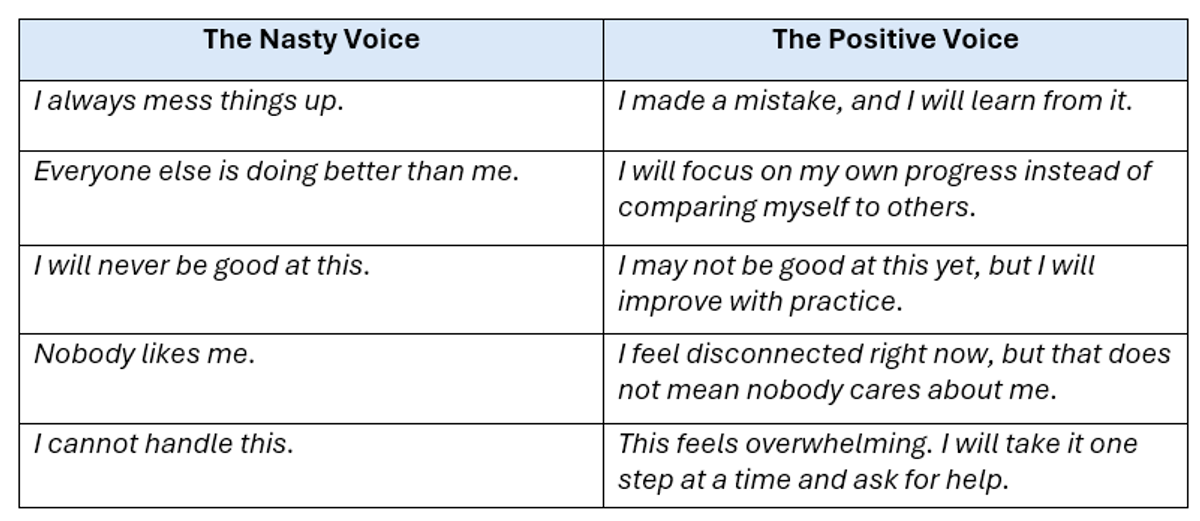
Give your positive voice more room
Start paying attention to what you say to yourself, especially when you are stressed or disappointed. Write down the thoughts that come up most often, then consider what your positive voice could say in response.
You will not always believe the positive response immediately, and that is okay. The point is not to force yourself to feel happy or confident all the time. It is to give yourself a fairer, more balanced perspective.
You can be disappointed and still have hope. You can recognize a problem and still believe you have options. You can acknowledge what went wrong without deciding everything will go wrong.
Your nasty voice does not get to define your future. Give your positive voice a chance to be heard. You might be surprised by what changes when you treat yourself with the same patience, kindness and encouragement you would offer about a friend.
Youtube: @dr.laurawhereworkmeetslife
Facebook: @Dr.Laura.whereworkmeetslife
Instagram: @dr.laura.live
Tik Tok: @drlaura.live
X: @drlauralive
Dr. Laura Hambley Lovett is an award winning Organizational Psychologist, Keynote Speaker, Business Leader, International Bestselling Author, and Podcast Host of the highly acclaimed podcast Where Work Meets Life™. She is a sought-after thought leader on workplace psychology, the future of work, and career development with over 25 years of experience. Dr. Laura is passionate about creating cultures that attract top talent and where people stay and thrive.
Dr. Laura has founded several psychology and consulting practices, including Canada Career Counselling in 2009, where registered psychologists across the country have helped thousands of Canadians navigate their career and workplace challenges, while supporting organizations to develop thriving leaders and cultures. She holds a Ph.D. in Industrial/Organizational Psychology from the University of Calgary, where she is currently an Adjunct Professor actively conducting research on toxic leadership across North America.
Her new book about toxic bosses, I Wish I’d Quit Sooner: Practical Strategies for Navigating and Escaping a Toxic Boss, endorsed by Dr. Marshall Goldsmith, was released on January 13, 2026, and became a #1 Amazon bestseller in Workplace Process & Infrastructure, as well as an Amazon International Bestseller. Drawing from her research and decades of experience, the book offers insight, validation, and practical strategies for those navigating, escaping, and recovering from a toxic boss at any stage of one’s career.
She has published two psychological thrillers, Losing Cadence and Finding Sophie, which aim to captivate readers while raising awareness about mental health and domestic violence. These novels are currently being adapted into a television series and inspired her to co-found WITH HER, a movement to end violence against girls and women. In recognition of her impactful work, Dr. Laura received a Canadian Women of Inspiration Award as a Global Influencer in 2018.